
Research Organization
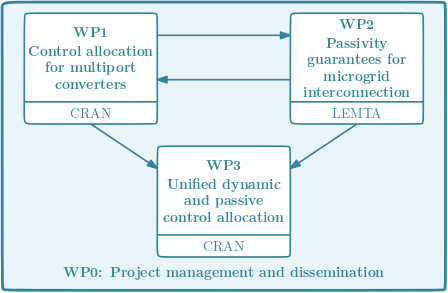
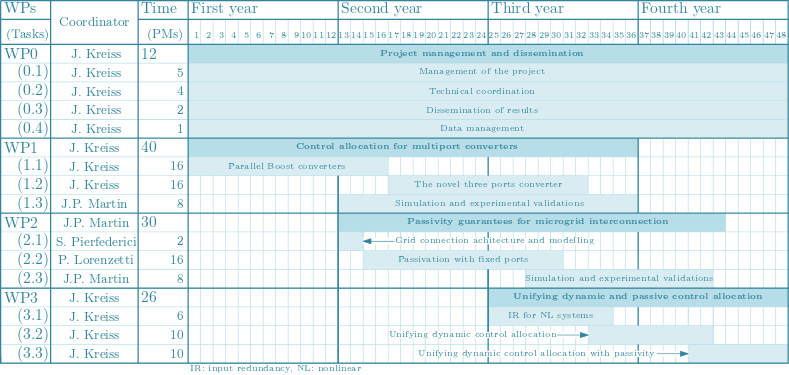
The work is structured into three main technical work packages (WP), supported by a management module
Project management and dissemination
WP0 ensures the smooth execution of the project over its 48-month duration. It covers administrative and financial monitoring, technical coordination between partners (CRAN and LEMTA), and the rigorous management of research data. A key component of WP0 is the dissemination of results to the scientific community and the general public through a dedicated website, social media presence, and open-access publications. Jérémie Kreiss is the coordinator of WP0.
This task ensures the administrative and financial monitoring of the project over its 48-month duration. It involves organizing regular meetings to track progress against objectives and ensuring that all deliverables are submitted on time. Corrective actions, such as resource reallocation, will be implemented if deviations from the plan occur.
Led by the coordinator, this task focuses on the scientific coherence of the project. It manages the interaction between the different partners (CRAN and LEMTA) and ensures that the technical requirements of each Work Package are met.
The goal is to maximize the impact of CASIMIR’s research. This includes publishing in high-impact journals, presenting at international conferences, and communicating with the general public through a dedicated website and social media.
A comprehensive Data Management Plan (DMP) will be established within the first 6 months. This task ensures that all research data generated during the project is stored, organized, and shared according to FAIR principles (Findable, Accessible, Interoperable, Reusable).
Control allocation for multiport converters
WP1 focuses on the control of isolated multiport converters operating independently of the main grid. The primary objective is to develop Dynamic Control Allocation methods that exploit the system’s degrees of freedom (redundancy). By intelligently managing how current is distributed among multiple sources (such as parallel Boost converters or the novel Three-Port Converter), we aim to maximize energy efficiency and minimize losses without compromising voltage stability or hardware safety.
This task uses the well-established architecture of parallel Boost converters as a starting point. We will analyze this system to identify its “degrees of freedom”—the different ways current can be distributed among the parallel branches. The goal is to design a control strategy that optimizes this distribution (e.g., to reduce heat and wear) while maintaining a stable output voltage.
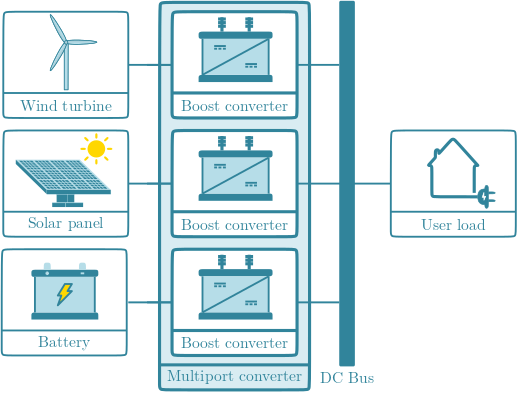
We will study a specific “frugal” converter architecture that connects a renewable source, a battery, and a load with fewer components than traditional designs. Because this system is highly nonlinear, we will develop specific dynamic control allocation methods to manage its energy flows efficiently.

All control strategies developed in Tasks 1.1 and 1.2 will first be rigorously tested in MATLAB/Simulink simulations. Once validated, they will be implemented on a real-world experimental setup at LEMTA using a dSPACE MicroLabBox rapid prototyping platform.
Passivity guarantees for microgrid interconnection
WP2 addresses the critical challenge of connecting several islanded units to the larger DC grid. To prevent the instability often caused by such connections, we design specific interconnection converters that act as a bridge between the unit and the network. The core scientific goal is to enforce passivity at the physical interconnection ports using IDA-PBC (Interconnection and Damping Assignment Passivity-Based Control) methods. This guarantees a “plug-and-play” behavior, ensuring that adding or removing a unit never destabilizes the global grid.
To connect an islanded unit to the main grid, a specific hardware interface is required. In this task, we will analyze various converter architectures to design an “interconnection converter” that acts as a bridge, managing power flow between the unit and the grid.

This task focuses on the control theory aspect. We will use the IDA-PBC (Interconnection and Damping Assignment Passivity-Based Control) method to design controllers that make the multiport converters behave “passively”. This ensures that when the unit is plugged into the grid, it does not create instability.
The passivation strategies will be validated experimentally. We will test the ability of the converters to connect and disconnect from a simulated grid without causing voltage oscillations or failure, proving the “plug-and-play” capability of our approach.
Unified dynamic and passive control allocation
WP3 aims to generalize the specific results obtained in WP1 and WP2 into a unified theoretical framework. By abstracting the physical properties of the converters, we seek to develop a rigorous mathematical methodology for Nonlinear Control Allocation that is applicable to a wide range of systems. This unified approach combines the performance benefits of dynamic allocation (optimization and efficiency) with the robust stability guarantees of passivity, providing a versatile tool for future complex energy systems.
This theoretical task aims to generalize the findings from the specific converters in WP1. We will use nonlinear geometric control theory to mathematically define “input redundancy” for any type of nonlinear system, identifying the available degrees of freedom in a rigorous way.
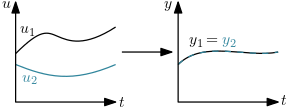
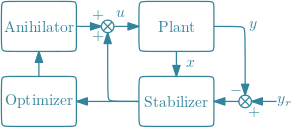
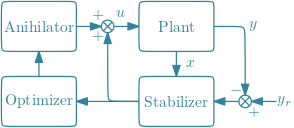
We will develop a generic methodology to design the three key components of dynamic control allocation (the stabilizer, the optimizer, and the annihilator) for nonlinear systems. This will allow the methods developed in CASIMIR to be applied to a much wider range of engineering problems beyond power electronics.
The final task merges the two main pillars of the project. We will extend the unified control allocation framework to include passivity guarantees. The result will be a comprehensive control design method that offers both the performance optimization of allocation and the stability guarantees of passivity.